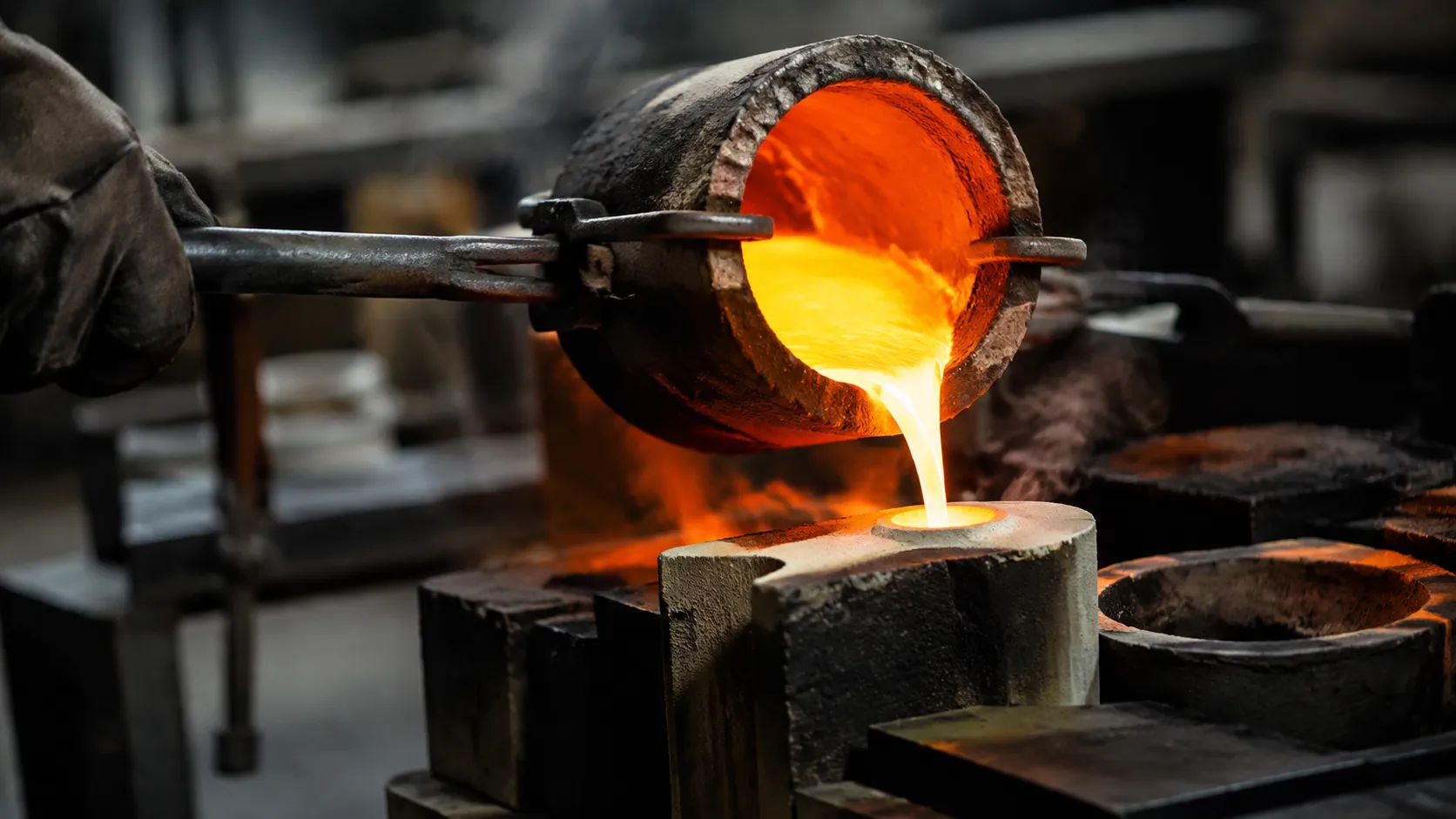
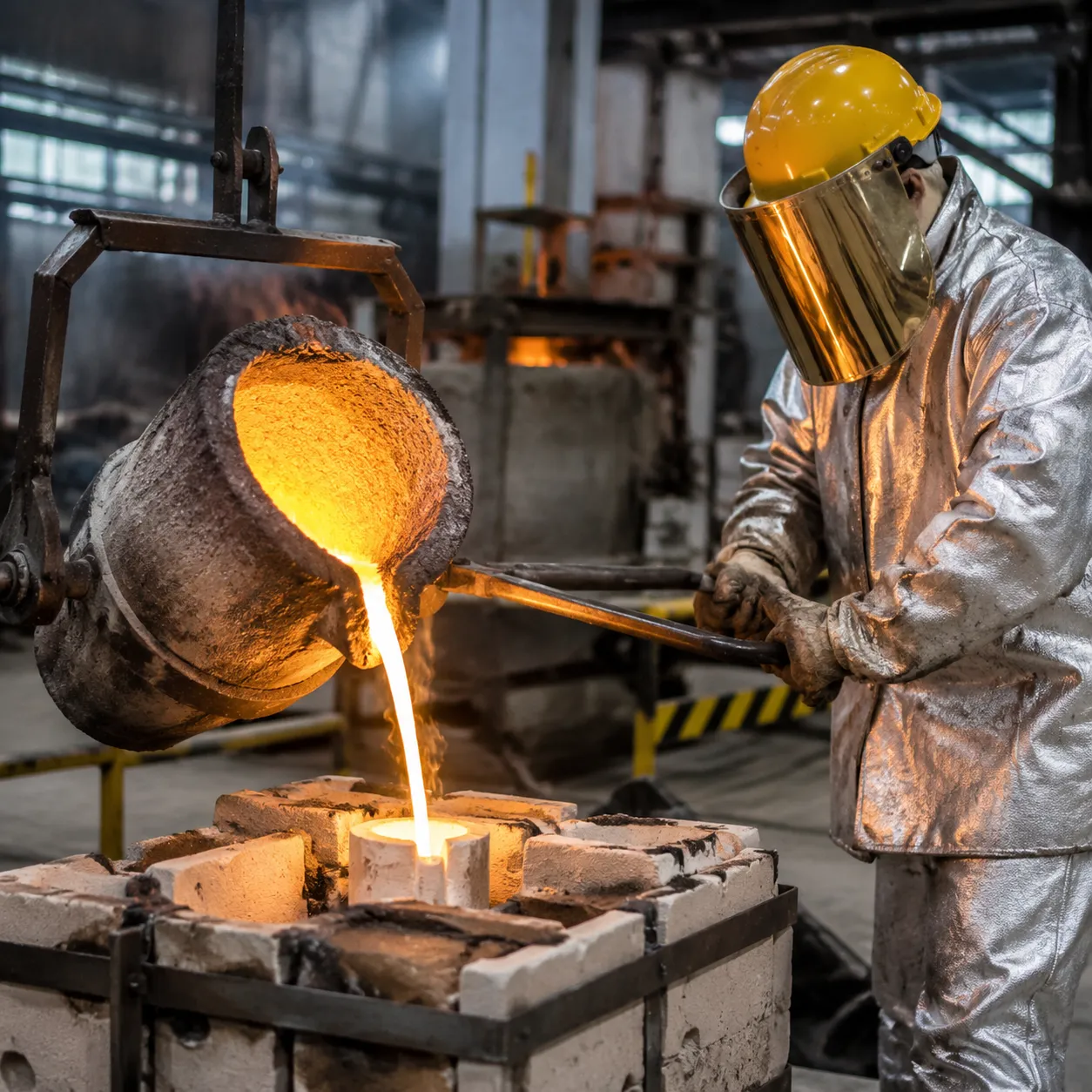
The aluminium investment casting process turns a disposable wax pattern and multi-layer ceramic shell into a pourable ceramic mold, so molten metal can form near-net-shape aluminium parts with tight tolerances and a fine surface finish. This guide walks the lost-wax casting sequence from pattern and shell build through dewaxing and foundry pouring, then covers alloy choices, industrial uses, and how the route compares with die casting, sand casting, and CNC machining.
What is Aluminium Investment Casting?
Aluminium investment casting is a high-precision manufacturing process engineered to produce complex, lightweight metal components with exceptional dimensional accuracy. By combining the natural weight-saving benefits of aluminium with the geometric freedom of lost-wax techniques, this process delivers near-net-shape parts built for demanding global applications.
Definition and Core Concepts
Aluminium investment casting relies on a disposable wax pattern to form a refractory ceramic mold.[8] Once the ceramic hardens, the wax is removed to leave an exact cavity, which is filled with molten metal.
- Near-Net-Shape Production: Drastically reduces raw material waste and eliminates secondary machining operations.
- Complex Geometry Integration: Consolidates multi-piece assemblies into a single cast aluminium component.
- High Metallurgical Integrity: Yields sound, dense microstructures capable of meeting stringent industrial performance criteria.
How Lost-Wax Casting Works for Aluminium
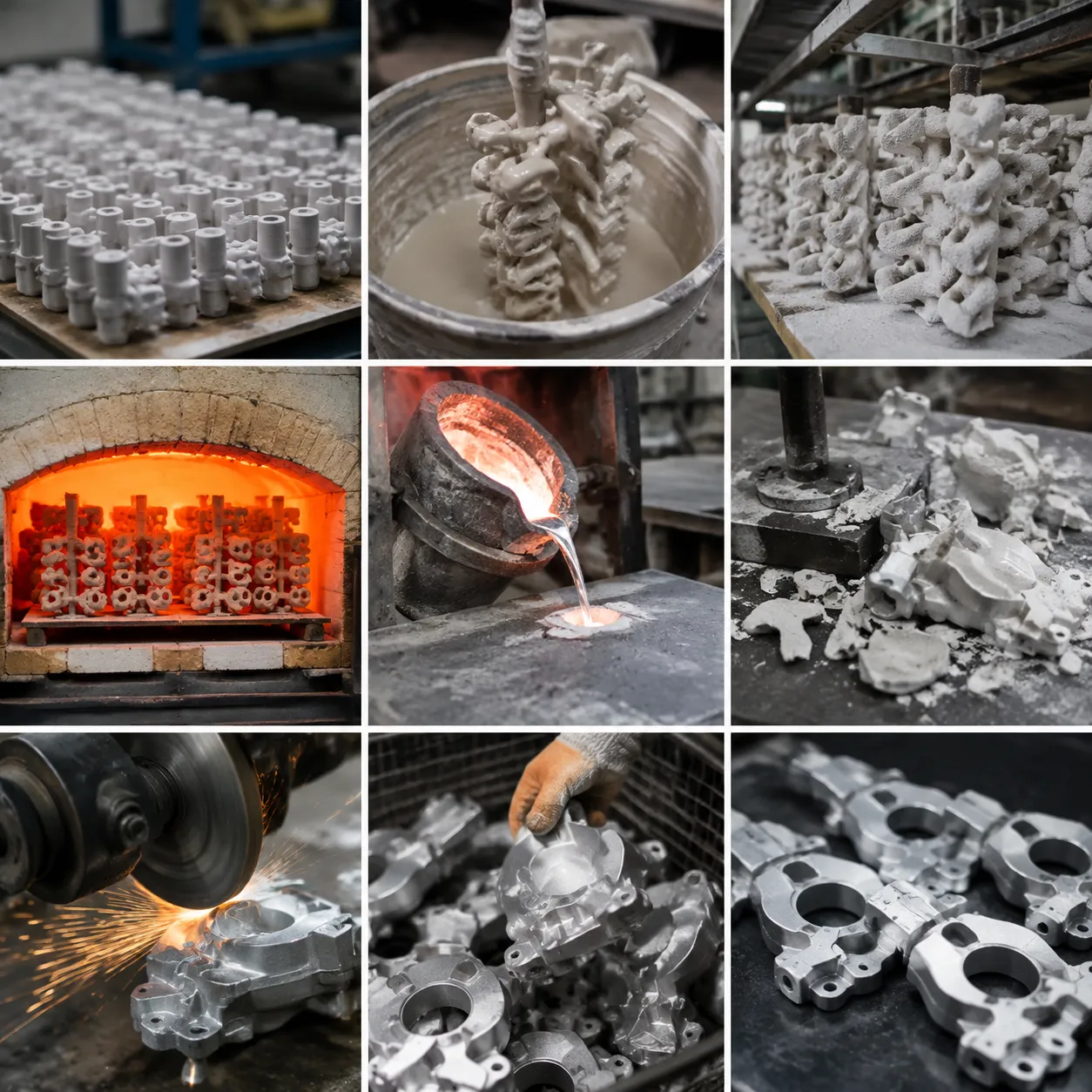
The lost-wax casting cycle follows a controlled, highly repeatable sequence:[5]
- Wax Pattern Creation: Industrial wax is injected into a precision mold die to create accurate pattern replicas.
- Tree Assembly: Multiple wax patterns are mounted to a central wax sprue to form a pourable tree structure.
- Ceramic Shell Building: The assembly is dipped into liquid ceramic slurry and stuccoed with sand repeatedly to build a rigid ceramic mold.
- Dewaxing: The shell is heated in an autoclave, melting away the wax pattern and leaving a pristine mold cavity.
- Foundry Pouring: The ceramic shell is preheated, and molten aluminium is poured into the hollow mold cavity.
- Shell Knockout & Finishing: After cooling, the ceramic shell is vibrated off, and individual components are cut from the tree and finished.
Key Characteristics of Investment Cast Aluminium
- Tight Tolerances: Achieves precise tolerances (commonly on the order of ±0.1 mm per 25 mm under controlled foundry practice), reducing post-processing costs.[1]
- Superior Surface Finish: Delivers smooth surface finishes commonly in the Ra 3.2-6.3 µm band straight out of the mold.[2]
- Thin-Wall Capability: Casts uniform wall thicknesses often down to about 1.5 mm without sacrificing structural integrity.[3]
- High Strength-to-Weight Ratio: Combines low material density with excellent mechanical properties for weight-sensitive applications.
The Step-by-Step Aluminium Investment Casting Process
At our foundry, our precise aluminium investment casting process combines proven lost-wax techniques with modern metallurgical controls to manufacture lightweight, high-integrity components with exceptionally tight tolerances.
Pattern Creation and Wax Tree Assembly
We begin by injecting specialized wax into metal tooling dies to create identical replicas of your component.
- Wax Pattern Production: Every wax pattern is produced with high precision, pre-calculated to offset alloy shrinkage during solidification.
- Tree Assembly: We assemble individual wax patterns around a central wax runner (sprue). This tree structure creates the channel system through which liquid metal will later flow.
Ceramic Shell Building and Stuccoing
To turn the wax assembly into a pourable mold, we build a multi-layered refractory shell around the wax tree.
- Slurry Dipping: We submerge the wax tree into a liquid ceramic slurry to form a fine prime layer.
- Stuccoing: Fine refractory sand is rained onto the wet surface to add structural strength.
- Shell Layering: We repeat the dipping and stuccoing sequence multiple times, drying each layer under climate-controlled conditions until a heavy-duty ceramic shell is formed.
Dewaxing and Mold Preheating
Once the ceramic shell cures completely, we remove the inner wax to create the hollow cavity.
- Autoclave Dewaxing: The assembly goes into a steam autoclave where rapid heat melts and drains the wax out, leaving an intact ceramic mold.
- High-Temp Firing: We heat the empty ceramic shell in a kiln. This burns off residual wax, cures the refractory material, and preheats the mold to prevent thermal shock during pouring.
Aluminium Melting, Pouring, and Shell Knockout
The final stage transforms molten metal into finished, near-net-shape parts.
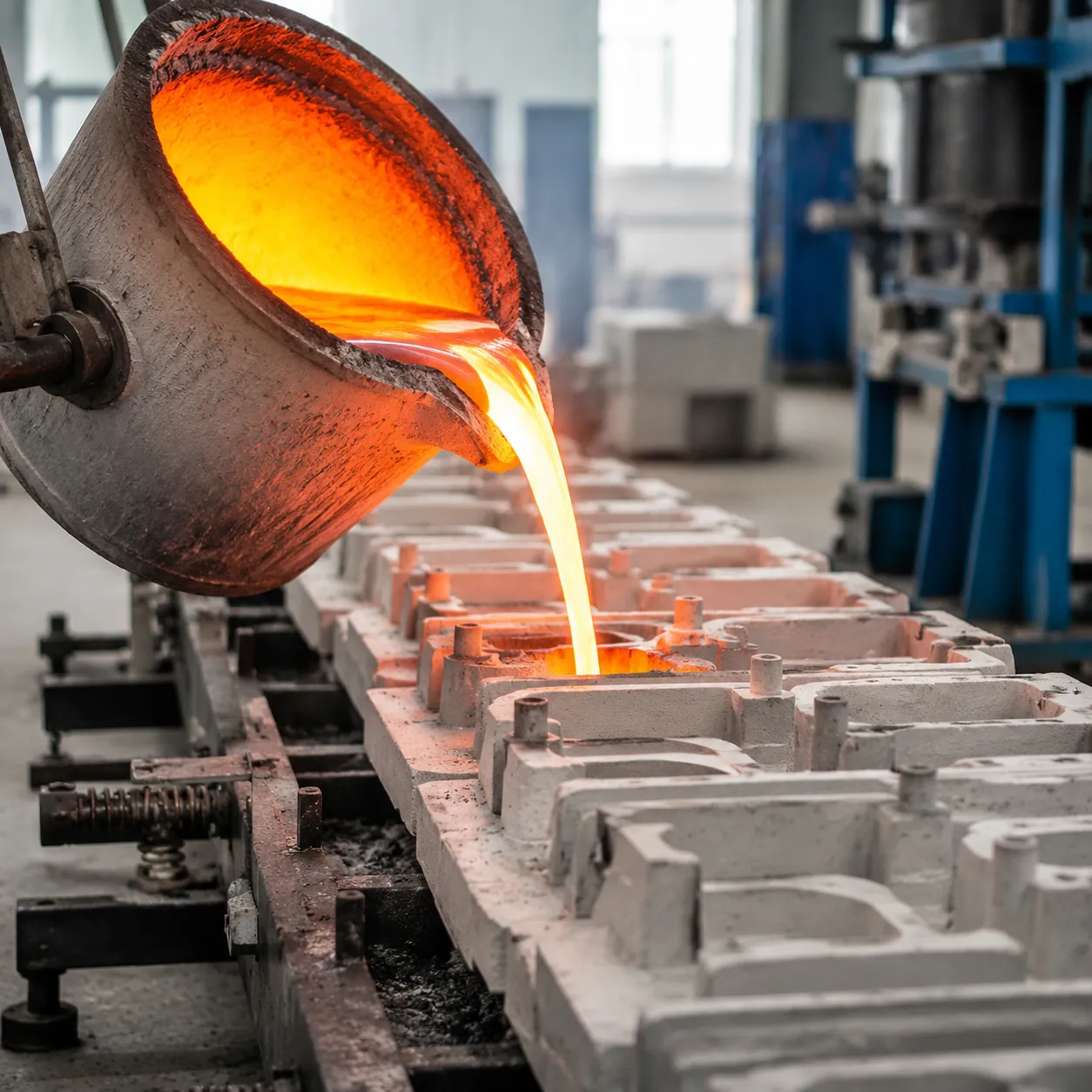
- Foundry Pouring: We melt verified aluminium alloys, degas the molten metal to eliminate porosity, and pour it precisely into the heated ceramic shell.
- Shell Knockout: Once the aluminium cools and solidifies, we break away the ceramic shell using high-frequency vibration and water blast equipment.
- Cut-Off & Finishing: The castings are cut from the tree, degated, and prepared for final heat treatment or CNC finishing.
Key Advantages of the Aluminium Investment Casting Process
The aluminium investment casting process offers clear structural and economic benefits that traditional fabrication techniques struggle to replicate. By pairing lightweight aluminium alloys with precision lost-wax methods, we produce near-net-shape components that minimize post-processing while maximizing strength.
Exceptional Dimensional Accuracy and Surface Finish
Precision is the core strength of investment casting. Building ceramic shells around high-precision wax patterns allows us to maintain strict consistency across high-volume production runs.
- Superior Surface Quality: Reaches standard surface finishes of about 125 RMS or smoother, eliminating the need for aggressive grinding or secondary surface treatments.[2]
- Tight Tolerances: Consistently holds dimensional tolerances commonly down to about ±0.005 inches per inch on well-controlled features, ensuring critical mating parts align accurately.[1]
- Minimal Distortion: Controlled thermal expansion and cooling prevent structural warping, preserving original design specifications.
Ability to Cast Complex Geometries and Thin Walls
Conventional tooling often restricts design options, but tailored lost-wax casting removes those barriers. Advanced mold design gives engineers the freedom to merge multi-part assemblies into a single cast piece.
- Thin-Wall Capabilities: Reliably flows molten metal into wall sections often down to about 1.5 mm without risking structural voids or defects.[3]
- Complex Internal Features: Specialized wax cores form intricate internal fluid channels, undercuts, and hollow cavities that standard CNC cutting tools cannot access.
- Component Integration: Combining multiple parts into one single casting reduces assembly labor and weld joints - a crucial requirement when producing lightweight aerospace and energy components.
Material Savings and Reduced Machining Costs
| Efficiency Factor | Heavy CNC Machining | Aluminium Investment Casting |
|---|---|---|
| Material Yield | Low (up to 70% turned into chips) | High (near-net shape with minimal scrap) |
| Secondary Machining | Extensive milling and turning needed | Light finishing on critical surfaces only |
| Tooling Wear | High wear from cutting away stock | Minimal wear, extending machine tool life |
- Near-Net-Shape Production: Casting directly to final geometry preserves raw material and lowers raw stock purchasing requirements.
- Shorter Cycle Times: Eliminating hours of rough milling drastically cuts down machining time and accelerates overall delivery schedules.
Common Aluminium Alloys for Investment Casting
We select specialized aluminium alloys to match the precise mechanical and thermal demands of your final part. Controlling the metallurgical composition during the aluminium investment casting process allows us to achieve optimum strength, corrosion resistance, and weight savings.
A356 and A357 Structural Alloys
A356 and A357 are the primary choices for high-integrity structural components. Both alloys feature excellent fluidity during foundry pouring, low susceptibility to hot tearing, and exceptional weldability.
- A356 (nominal Al-Si-Mg family): Offers outstanding castability and strong corrosion resistance.[4] When heat-treated to T6 temper, it provides excellent ductility and high yield strength for automotive frames, pump housings, and structural brackets.
- A357 (Al-7Si-0.5Mg-0.12Be): Contains higher magnesium levels and trace beryllium, delivering superior tensile and yield strength compared to A356 while maintaining excellent fatigue resistance for critical aviation fittings.
C355 High-Strength Aluminium Alloy
When components require elevated mechanical properties at higher operating temperatures, C355 (Al-5Si-1.3Cu-0.5Mg) is our preferred material.
- Enhanced Mechanical Strength: The addition of copper significantly boosts hardness, yield stress, and ultimate tensile strength over standard 350-series alloys.
- Superior Pressure Tightness: C355 maintains exceptional pressure tightness, making it resistant to leaks under severe hydraulic loads.
- Common Applications: High-speed pump impellers, air-conditioning compressor housings, aircraft control components, and performance engine parts.
Alloy Selection Criteria for Engineering Applications
| Selection Factor | Engineering Consideration | Top Alloy Choice |
|---|---|---|
| Structural Integrity | Maximum strength-to-weight ratio with fatigue resistance | A357-T6 |
| Pressure Tightness | Hermetic sealing for high-pressure fluid or gas containment | C355 |
| Corrosion Resistance | Durability in marine or harsh ambient environments | A356 |
| Thermal Stability | Retaining mechanical properties at elevated temperatures | C355 |
| General Versatility | Balanced ductility, high castability, and cost efficiency | A356 |
Industrial Applications of Aluminium Investment Castings
We leverage the aluminium investment casting process to produce lightweight, high-strength parts with exceptional dimensional accuracy across demanding industries. By combining lost-wax casting with precision machining, we deliver production-ready components that meet strict performance standards.
Aerospace and Aviation Components
- Flight Control Systems: Brackets, levers, and actuator housings requiring tight tolerances.
- Environmental Systems: Complex ducting connectors, heat exchangers, and valve bodies.
- Avionics Enclosures: Lightweight radar and electronics housings that offer excellent heat dissipation and shielding.
Automotive and High-Performance Vehicles
We supply precision investment cast parts for automotive aftermarket programs alongside specialized custom automotive tuning parts designed to withstand extreme thermal stress and mechanical strain.
- Powertrain Systems: Turbocharger impellers, intake manifolds, and high-performance gearbox and exhaust components.
- Chassis & Suspension: Steering knuckles, control arm mounts, and brake caliper housings.
- Motorsport Hardware: Custom bracketry and structural engine mounts optimized for racing applications.
Medical and Precision Equipment
Medical devices demand smooth surface finishes, corrosion resistance, and high geometric accuracy. Our investment casting process eliminates internal voids to ensure maximum reliability for critical healthcare applications.
- Surgical Robotics: Lightweight joints, handles, and articulation arms for robotic surgery.
- Diagnostic Devices: Structural chassis and frames for portable imaging equipment and ultrasound units.
- Laboratory Instrumentation: Precision pump bodies, liquid handling bases, and centrifuge mounts.
Military and Defense Hardware
We cast defense-grade aluminium components that offer high impact resistance, durability, and strict adherence to industry standards.
- Unmanned Aerial Vehicles (UAVs): Lightweight airframe connectors, camera gimbals, and propulsion mounts.
- Optical & Targeting Systems: Night-vision optic mounts, laser rangefinder chassis, and scope housings.
- Tactical Hardware: Ruggedized radio enclosures, vehicle mounting brackets, and weapons system hardware.
Aluminium Investment Casting vs. Other Manufacturing Methods
Choosing the optimal production method depends on your component's geometry, production volume, surface finish requirements, and overall budget. The aluminium investment casting process offers distinct trade-offs when compared to other popular metalworking options.
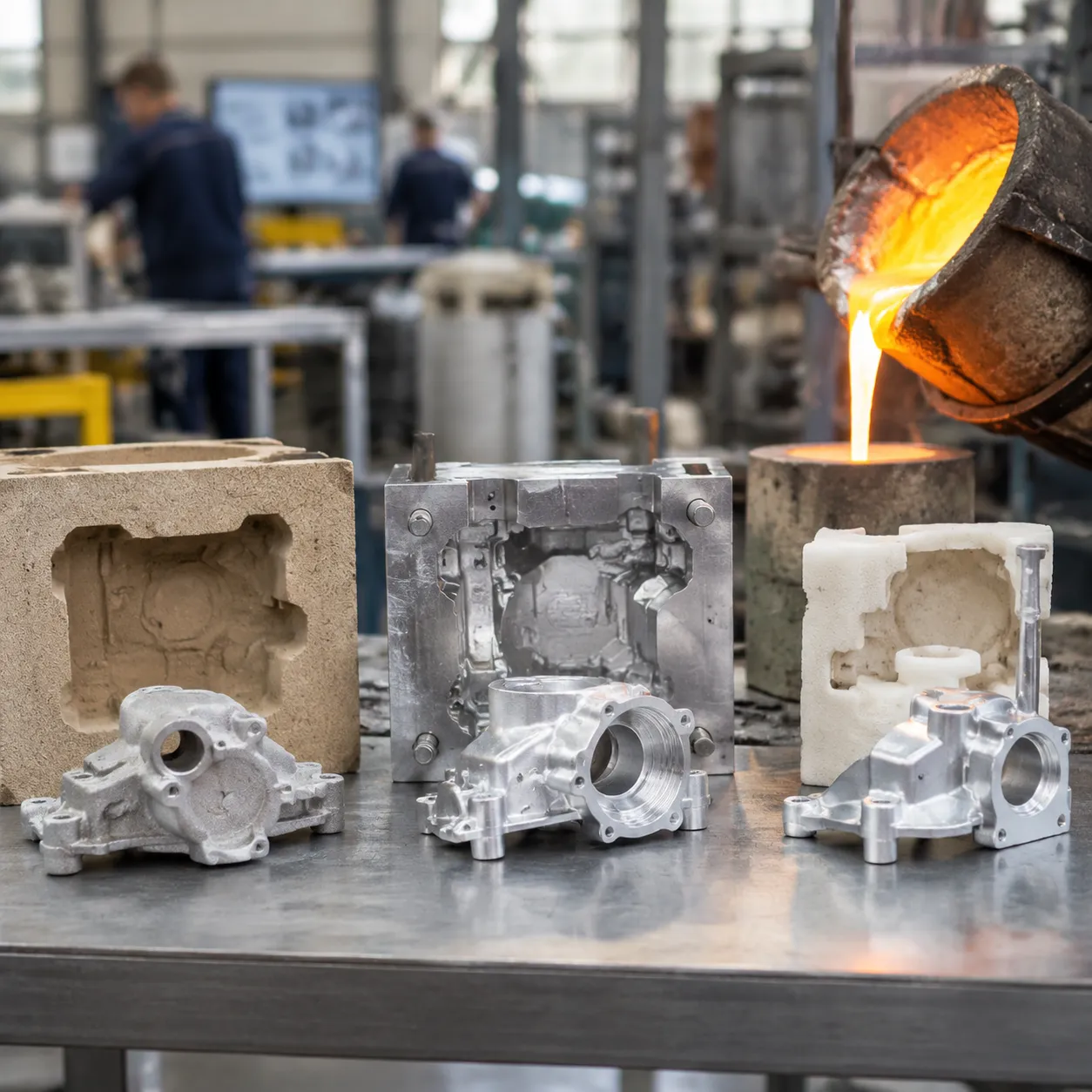
Investment Casting vs. Aluminium Die Casting
Both methods use liquid metal to shape components, but they serve different production scales and design requirements:
Tooling Expense: Investment casting uses aluminum dies to make wax patterns, keeping initial tooling costs significantly lower than the heavy steel dies required for high-pressure die casting.
Geometrical Freedom: Lost-wax casting supports complex internal voids, thin walls, and undercuts that are impossible to eject from rigid die-casting tooling.
Structural Soundness: Investment cast parts exhibit less gas porosity, making them easier to heat-treat and weld compared to standard die-cast parts.
Investment Casting vs. Sand Casting
Sand casting remains popular for large, basic shapes, while investment casting focuses on precision and fine detail:
Dimensional Accuracy: The aluminium investment casting process delivers tight tolerances, eliminating the need for excessive secondary finishing.
Surface Finish: Building a fine ceramic shell yields smooth surface finishes (commonly about 125 RMS or better), avoiding the coarse, gritty texture left by sand molds.[2]
Weight & Material Savings: Near-net shape capabilities mean less wasted metal, allowing for lighter, thinner-walled structural parts.
Investment Casting vs. CNC Machining
Subtractive machining cuts metal away from a solid block, whereas investment casting places material only where your design needs it:
Material Efficiency: Machining complex enclosed structures creates massive raw material scrap. Investment casting forms intricate hollow sections with minimal waste.
Production Economics: CNC machining costs scale linearly per part, making it ideal for small prototypes. Casting dramatically lowers per-unit costs as volume increases.
Integrated Manufacturing: For features requiring sub-micron precision, we combine foundry pouring with our downstream precision CNC machining services - giving you complex cast geometries with tight-tolerance mating surfaces.
Choosing an Aluminium Investment Casting Supplier
Quality Certifications and Industry Standards
We maintain strict compliance with international manufacturing benchmarks to guarantee every cast component meets required mechanical properties and tight tolerances. Our comprehensive quality assurance certifications ensure full material traceability and process repeatability across all production runs.
- ISO 9001: Standard quality management systems for consistent output.
- AS9100: Aerospace-grade quality standards for mission-critical components.[6]
- IATF 16949: Specialized quality management for automotive supply chains.[7]
Tooling, Prototyping, and Production Capabilities
We streamline the aluminium investment casting process by combining traditional craftsmanship with modern digital manufacturing techniques. Utilizing advanced mold design and simulation software allows us to analyze solidification paths and eliminate defects before cutting physical tooling.
- Rapid Prototyping: 3D-printed wax patterns for fast design validation without upfront tooling costs.
- Tooling Optimization: In-house die creation engineered for maximum tool life and exact repeatability.
- Precision CNC Machining: Integrated finish machining to achieve ultra-tight tolerances on functional mating surfaces.
Inspection, Testing, and Quality Assurance
Preventing subsurface flaws and material defects requires rigorous inspection protocols prior to dispatch. We deploy dedicated testing equipment to verify dimensional fidelity, mechanical strength, and structural soundness on every production batch.
- Chemical Analysis: Optical emission spectrometry to verify exact alloy compositions.
- Dimensional Verification: High-precision Coordinate Measuring Machines (CMM) and 3D optical scanning.
- Non-Destructive Testing (NDT): Radiographic X-ray inspection and liquid penetrant testing to detect internal porosity or surface micro-cracks (see our testing facilities).
Need drawings reviewed for wax tooling, shell schedule, or alloy temper? Request a quote.
References
- ASTM B618/B618M - Standard Specification for Aluminum-Alloy Investment Castings ↩
- Investment Casting Institute - Industry association (process & capability overview) ↩
- DiVA Portal - Thin-wall / precision casting research (PDF) ↩
- The Aluminum Association - Aluminum materials & industry resources ↩
- Total Materia - Investment casting process article ↩
- SAE AS9100D - Quality Management Systems for Aviation, Space, and Defense ↩
- AIAG - Automotive quality resources (IATF 16949 ecosystem) ↩
- NASA NTRS - Investment casting process research citation ↩